
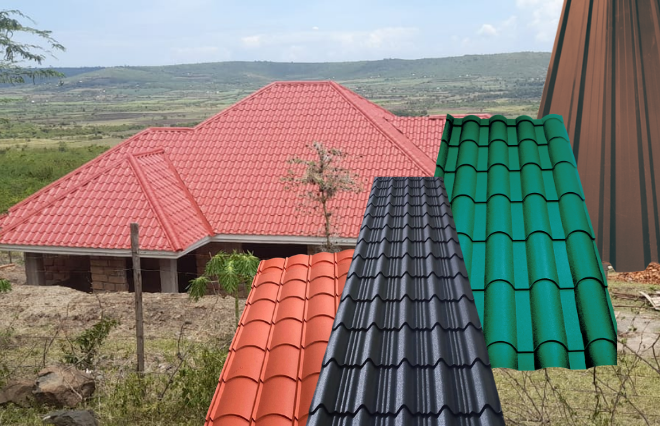
Description
Overview: The Kenyan Mabati Market
Color-coated steel roofing sheets—commonly known as mabati—dominate residential, commercial, and agricultural building construction across Kenya. Transitioning away from traditional asbestos and heavy concrete tiles, modern Kenyan builders prioritize high-tensile Alu-Zinc (Galvalume) coated steel. This technology combines aluminum’s corrosion resistance with zinc’s sacrificial protection, providing decades of service under intense equatorial sun, coastal salt spray, and heavy seasonal rainfall.
Leading Mabati Profiles in Kenya
The choice of profile determines structural strength, minimum slope requirements, overall aesthetic appeal, and total roofing cost.
1. Box Profile
-
Design & Feel: Clean, trapezoidal ridges with deep trough channels.
-
Best Applications: Modern residential homes, commercial godowns, industrial sheds, and school roofs.
-
Key Advantages: Excellent water discharge capacity during heavy storms, minimal overlap loss, and high structural rigidity across purlins.
2. Tile Profiles (Versatile Mabati, Roman Tile, Orientile, Zee Tile)
-
Design & Feel: Pressed steel sheets engineered to mimic traditional ceramic or clay roofing tiles.
-
Best Applications: High-end residential bungalows, maisonettes, villas, and institutional buildings.
-
Key Advantages: Delivers a classic architectural appearance without the heavy weight of concrete tiles, eliminating the need for reinforced roof trussing.
3. Corrugated (Normal / Traditional) Mabati
-
Design & Feel: Classic sinusoidal wave pattern.
-
Best Applications: Budget residential structures, temporary site hoardings, rural housing, farm sheds, and perimeter fencing.
-
Key Advantages: Lowest initial purchase price, easy on-site cutting, and universally available across all hardwares nationwide.
4. Standing Seam / Concealed Fastener Profiles (e.g., Klip-Lok)
-
Design & Feel: Vertical raised seams joined by hidden clips underneath the sheet surface.
-
Best Applications: Low-pitch modern architectural roofs (2-5 degree slope), solar-equipped commercial roofs, and coastal properties.
-
Key Advantages: 100% unpierced surface eliminates screw hole leaks and allows uninhibited thermal expansion.
Gauge & Surface Finish Selection
In Kenya, structural performance and pricing are heavily governed by Gauge (sheet thickness) and Coating Finish.
Sheet Thickness Comparison:
Gauge 28 (Thicker / Premium)  | ==========================> ~0.32mm
Gauge 30 (Standard / Popular) | =====================>      ~0.25mm
Gauge 32 (Economy / Light)   | =================>          ~0.18mm–0.22mm
-
Gauge 28 (~0.32mm): Recommended for permanent family residences, high-wind areas, and commercial buildings. Highly resistant to foot-traffic deformation during installation.
-
Gauge 30 (~0.25mm): The most widely purchased gauge in Kenya. Striking a balance between affordability and durability for rental properties and standard homes.
-
Glossy Finish: Smooth, reflective paint layer that sheds rain easily and offers vibrant colors (Maroon, Tile Red, Charcoal Grey, Sky Blue).
-
Matte / Wrinkle / Texture Finish: Premium anti-glare, textured powder-like coat that reduces sun reflection, hides minor scratches, and offers higher UV fade resistance.
Market Profile & Price Reference Index
| Profile | Typical Gauge | Finish Options | Estimated Price Range (KES) | Best Application |
| Corrugated Mabati | G30, G32 | Uncolored (Alu-Zinc) / Glossy | KES 700 – KES 1,500 / sheet | Budget housing, farm structures |
| Box Profile | G28, G30 | Glossy, Matte, Alu-Zinc | KES 520 – KES 850 / meter | Modern residential & commercial |
| Versatile / Tile | G28, G30 | Matte / Wrinkle, Glossy | KES 610 – KES 950 / meter | Premium homes, maisonettes |
| Roman / Zee Tile | G28, G30 | Textured Matte, Glossy | KES 620 – KES 980 / meter | Executive residential roofs |
| Standing Seam | G24, G26, G28 | Matte, PVDF, Alu-Zinc | KES 850 – KES 1,400 / meter | Low pitch & architectural designs |
Essential Buyer Checklist for Roof Construction
-
Verify KEBS Certification: Ensure the roofing sheets carry the Kenya Bureau of Standards mark of quality to avoid under-gauge, non-calibrated steel sheets.
-
Match Purlin Spacing to Profile: Box profiles generally allow purlin spacing up to 900mm–1000mm, whereas tile profiles require precise purlin spacing (typically 350mm to 400mm centers) to align with step presses.
-
Include Roof Accessories: Always budget for matching accessories—such as ridge caps, valley trays, barge boards (side caps), and rubber-washer self-tapping screws—to guarantee a leak-proof finish.
-
Underlayment Protection: Incorporate double-sided reflective Aluminium Foil Roof Insulation directly under purlins to block up to 97% of radiant solar heat and prevent indoor condensation.
Reviews
There are no reviews yet.