
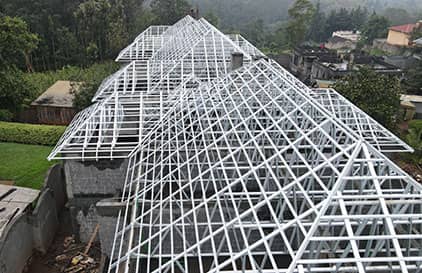
Description
What is Light Gauge Steel (LGS) and how much does it cost in Kenya?
Light Gauge Steel (LGS) is a cold-formed, high-tensile structural steel profile (typically Grade G550 with Alu-Zinc coating) used as a modern, engineered replacement for timber roof framing and wall structures. In Kenya, LGS roof truss materials cost between KES 2,500 and KES 3,500 per square meter, with installation ranging from KES 1,000 to KES 1,500 per square depending on roof span and structural design complexity.
System Architecture & Visual Guide
CAD-designed LGS trusses interlock using self-drilling screws, providing a perfectly aligned, straight roof line without heavy structural dead weight.
Key Specifications & Price List (Kenyan Market)
| Profile / Component | Technical Specification | Estimated Price Range (KES) | Primary Application |
| C-Channel Profile (C75 / C89) | 0.75mm – 1.00mm (Grade G550, AZ100) | KES 180 – KES 260 / meter | Main truss chords, rafters & webs |
| Hat Battens / Top Hat Purlins | 0.45mm – 0.55mm Alu-Zinc | KES 90 – KES 140 / meter | Purlins mounted for roof sheets/tiles |
| U-Track / Base Channel | 0.75mm – 1.00mm Bottom Track | KES 160 – KES 230 / meter | Base anchoring on ring beams |
| Complete LGS Truss System | Engineered design + Material supply | KES 1,800 – KES 3,500 / $m^2$ | Supply-only per roof area |
| Full Supply & Installation | Fabrication + On-site assembly | KES 2,800 – KES 4,800 / $m^2$ | Complete turn-key roofing project |
The Modern Standard: Why Kenyan Builders Are Switching to Light Gauge Steel
Traditional timber roof trusses present significant long-term structural liabilities for property owners in East Africa—including timber warping, sagging rooflines, fungal rot, and catastrophic damage from destructive termites.
Light Gauge Steel (LGS) technology replaces unreliable timber with precision-milled, high-tensile cold-formed steel profiles. Engineered using advanced CAD structural modeling, LGS components are pre-cut and pre-punched to millimeter precision, enabling fast, zero-waste assembly on residential, commercial, and institutional building projects nationwide.
Key Advantages of Light Gauge Steel Trusses
-
100% Termite & Pest Immune: Steel cannot be eaten or destroyed by termites, borers, or pests, guaranteeing permanent structural integrity.
-
Zero Warping or Shrinkage: Unaffected by rain or seasonal humidity shifts; maintains crisp, dead-straight rooflines permanently.
-
3x Faster Installation: Factory-cut channels feature pre-punched fixing holes and dimples for rapid on-site assembly using self-drilling fasteners.
-
Non-Combustible (Fireproof): High melting point protects structural stability during building fire emergencies.
-
High Strength-to-Weight Ratio: Up to 60% lighter than timber, placing far less dead load on foundation footings, columns, and concrete ring beams.
-
Corrosion Resistance: Coated with High-Tensile Zinc/Aluminium alloy (AZ100/AZ150) to prevent rust even in high-humidity regions.
Step-by-Step Engineering & Assembly Process
-
CAD Architectural Modeling: Roof dimensions are converted into 3D structural engineering software to calculate exact wind load and dead load requirements.
-
Precision Roll-Forming: High-tensile steel coils (G550 grade) are roll-formed into custom C-channel and U-track profiles cut to exact millimeter lengths.
-
Purlin & Ring Beam Anchoring: Base tracks are bolted directly onto concrete ring beams using chemical or expansion anchor bolts.
-
Truss Assembly & Erection: Individual truss frames are fastened using hex-head self-drilling screws and lifted into position before purlins and roof sheets (mabati) are installed.
Light Gauge Steel vs. Cypress Timber Trusses
| Performance Attribute | Light Gauge Steel (LGS) Trusses | Traditional Cypress Timber |
| Material Consistency | Uniform G550 factory grade; 0 flaws | Variable grain quality; knots, splits & dampness |
| Termite & Pest Protection | 100% Immune (No chemical treatment required) | Requires expensive, toxic anti-termite chemicals |
| Dimensional Stability | Straight & true for 50+ years | Warps, twists, and bows as wood dries out |
| Fire Safety Rating | Non-Combustible (Class A) | Highly Flammable |
| Site Waste | < 1% (Pre-engineered & pre-cut) | 10% – 20% off-cut timber waste |
| 25-Year Maintenance Cost | KES 0 (Zero repainting or structural repairs) | High (Termite treatments, sagging repairs) |
Frequently Asked Questions
Q1: Is Light Gauge Steel more expensive than timber in Kenya?
Initial material costs for quality LGS steel trusses are virtually identical to treated Cypress timber per square meter. However, because LGS installs 50% faster with zero off-cut waste and zero long-term termite maintenance, it delivers up to 30–40% lower overall lifetime cost.
Q2: What grade of steel is used for LGS roof trusses?
Standard structural LGS trusses in East Africa utilize Grade G550 steel coated with an Alu-Zinc (AZ100/AZ150) protective coating to combine extreme tensile strength with maximum corrosion defense.
Q3: What is the maximum span possible with Light Gauge Steel trusses?
LGS roof trusses can span up to 15 to 18 meters clear span without internal load-bearing support walls, making them ideal for residential open-plan living, churches, schools, and commercial godowns.
Q4: How are roofing sheets attached to LGS trusses?
Roofing sheets (such as Box Profile or Versatile Tile mabati) are secured directly onto LGS top-hat purlins using self-drilling roofing screws equipped with EPDM rubber washers.
Reviews
There are no reviews yet.