
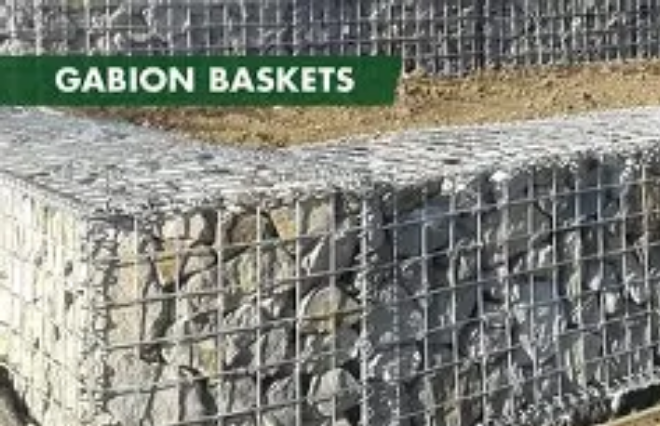
Description
Woven & Welded Gabion Boxes in Kenya: Technical Guide, Specs & Pricing
Quick Summary:
Gabion Baskets are heavy galvanized or PVC-coated wire mesh containers filled with hard rock or stone ballast to construct retaining walls, riverbank erosion barriers, culvert abutments, and decorative architectural features. In Kenya, gabions are manufactured in two structural formats: Woven Hexagonal Mesh (flexible, double-twisted wire ideal for civil works and soft soils) and Welded Wire Mesh (rigid, flush-faced grid ideal for architectural cladding and decorative retention). Standard unit dimensions include 2m × 1m × 1m, 1m × 1m × 1m, 2m × 1m × 0.5m, and Reno Mattresses (6m × 2m × 0.3m). Prices range from KSh 3,800 to KSh 12,500 per unit for woven mesh and KSh 7,000 to KSh 18,000 per unit for heavy welded mesh depending on wire thickness 2.5mm to 60mm
Technical Specifications & Pricing Matrix (Kenya)
| Gabion Type | Standard Dimensions (L×W×H) | Wire Diameter | Mesh Aperture | Nominal Weight (Empty) | Average Price Range (KES) | Primary Civil Application |
| Woven Hexagonal | 1.0m × 1.0m × 1.0m | 2.5mm – 3.0mm | 80 × 100mm | ~10 kg | KSh 3,800 – KSh 5,200 | Small drainage headwalls, garden retaining steps |
| Woven Hexagonal | 2.0m × 1.0m × 1.0m | 2.7mm – 3.4mm | 80 × 100mm / 100 × 120mm | ~18 kg | KSh 4,200 – KSh 7,500 | Riverbank stabilization, highway slopes, culverts |
| Woven Hexagonal | 3.0m × 1.0m × 1.0m | 3.0mm – 3.4mm | 100 × 120mm | ~26 kg | KSh 11,000 – KSh 14,500 | Heavy retaining walls, bridge abutments |
| PVC Coated Woven | 2.0m × 1.0m × 1.0m | 2.7mm core / 3.7mm outer | 80 × 100mm | ~20 kg | KSh 6,500 – KSh 9,500 | Acidic soils, coastal zones, riverbed scour protection |
| Reno Mattress | 6.0m × 2.0m × 0.3m | 2.2mm – 2.7mm | 60 × 80mm | ~32 kg | KSh 6,500 / $m^2$ – KSh 13,000 | Channel linings, spillways, riverbed erosion mattresses |
| Welded Mesh (3mm) | 2.0m × 1.0m × 1.0m | 3.0mm | 50 × 100mm / 75 × 75mm | ~22 kg | KSh 7,000 – KSh 9,000 | Perimeter retaining walls, site boundary fences |
| Welded Mesh (4mm) | 2.0m × 1.0m × 1.0m | 4.0mm | 50 × 100mm / 75 × 75mm | ~28 kg | KSh 8,500 – KSh 11,500 | Heavy architectural walls, exposed cladding |
| Welded Mesh (6mm) | 2.0m × 1.0m × 1.0m | 6.0mm Heavy Rod | 50 × 100mm | ~42 kg | KSh 12,000 – KSh 18,000 | Free-standing noise barriers, luxury landscape features |
Woven vs. Welded Gabions: Comparison & Selection Guide
| Feature | Woven Double-Twisted Gabions | Welded Wire Mesh Gabions |
| Manufacturing Method | Continuous double or triple-twisted hexagonal mesh weave | Resistance spot-welded steel grid panels |
| Flexibility & Settlement | High Flexibility: Flexes without breaking under uneven soil settlement | Rigid: Maintains crisp, straight square edges without bulges |
| Aesthetic Finish | Industrial / Organic (slightly curved panels when packed) | Clean, architectural, linear alignment |
| Stone Filling Speed | Medium (requires internal tensioning / tie wires to control bulging) | Fast: Rigid wire face holds shape while filling |
| Wire Diameter Range | 2.2mm – 3.4mm soft/medium tensile wire | 3.0mm – 6.0mm heavy structural steel rod |
| Corrosion Protection | Heavy Hot-Dip Galvanized / Galfan / PVC Coating | Heavy Galvanized / Galfan (Zn-Al alloy) |
| Best Used For | River training, embankment stabilization, landslide control | Exposed retaining walls, landscape benches, wall cladding |
Key Structural Advantages of Gabion Systems
-
Self-Draining & Zero Hydrostatic Pressure:
Unlike solid concrete retaining walls, rock-filled gabions are porous. Water drains freely through the stone void matrix, eliminating the build-up of hydrostatic pressure behind the structure—the leading cause of retaining wall failure.
-
Structural Flexibility & Differential Settlement:
Woven hexagonal gabions adapt dynamically to shifting or expanding sub-soils. The double-twist wire distribution absorbs ground movement and structural settlement without cracking or loss of integrity.
-
Cost Savings Over Reinforced Concrete:
Constructing a gabion retaining wall saves up to 40% to 50% in total project cost compared to concrete. They eliminate expensive concrete formwork, deep footings, and specialized curing times, utilizing locally sourced quarry stone or field stones.
-
Environmental Integration & Eco-Growth:
Over time, soil and silt settle inside the stone voids, allowing natural vegetation roots to establish. This bio-engineering process locks the rocks together and integrates the wall naturally into the surrounding landscape.
Frequently Asked Questions
Q1: What size and type of stones should be used to fill gabion baskets?
Use clean, hard, weather-resistant stone ballast or quarry rock with a diameter between 100mm and 250mm. Rocks must be larger than the mesh opening 80x100mm or 50x 100mm) to prevent stones from slipping through. Hand-pack the outer exposed face for a neat appearance and pour smaller ballast into the core.
Q2: How do you prevent gabion boxes from bulging when filling?
To maintain flat, straight faces:
-
Install internal cross-connecting tie wires (bracing wires) every $300\text{mm}$ layer during stone filling.
-
For long woven gabion walls, secure temporary wooden or steel formwork props on the front face until stone filling is complete.
-
Welded gabions naturally resist bulging due to their rigid grid strength, but middle bracing hooks should still be used on tall 1m panels.
Q3: How long do hot-dip galvanized gabion baskets last?
In standard dry or moderate soil conditions, heavy hot-dip galvanized gabions last 25 to 35+ years. In coastal zones or acidic water channels (e.g., rivers with industrial runoff), PVC-coated gabions are recommended, extending operational lifespan to 50+ years.
Reviews
There are no reviews yet.