
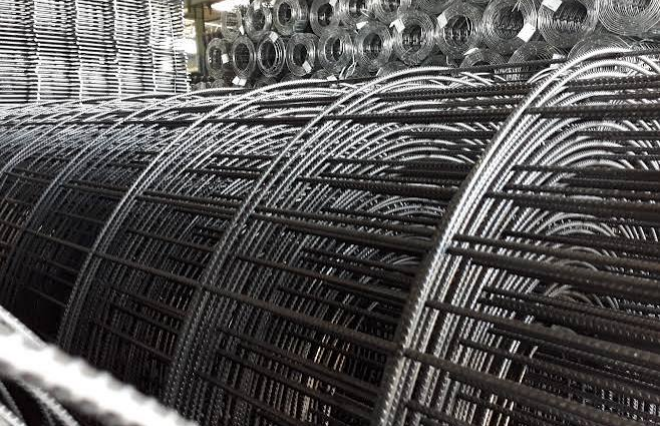
Description
Ribbed BRC Welded Mesh in Kenya: Specifications, Roll Sizes & Price Guide
Quick Summary:
BRC Welded Steel Mesh (British Reinforcement Concrete standard fabric) is a high-tensile wire mesh used to reinforce concrete slabs, foundations, driveways, and retaining walls. In the Kenyan construction market, BRC mesh is manufactured to BS 4483 / KS ISO 6935 standards and supplied in 2.1m × 48m rolls (covering 100.8 m²) or 2.4m × 4.8m flat sheets (covering 11.52 m²). Mesh gauges range from light-duty A66 and A98 to heavy structural A142, A193, and A252. Prices in Kenya range from KSh 3,200 to KSh 4,800 per flat sheet and KSh 24,000 to KSh 48,000 per 48-meter roll depending on wire diameter.
All standard BRC mesh fabric features a uniform 200mm × 200mm square grid spacing.
Key Structural Advantages in Concrete Reinforcement
-
Crack Propagation Prevention:
As concrete cures, thermal expansion and plastic shrinkage induce internal stress. BRC mesh distributes tensile loads evenly across the slab, preventing micro-fissures from expanding into structural cracks.
-
Speed & Labor Efficiency:
Laying pre-welded 2.1m × 48m rolls or 2.4m × 4.8m sheets cuts steel-fixing labor time by up to 70% compared to manually cutting, bending, and tying individual rebar (Y-bars) with binding wire.
-
Guaranteed Wire Spacing & Tensile Strength:
Resistance spot-welding at every wire intersection ensures accurate 200mm × 200mm spacing throughout. Machine-drawn high-tensile cold-worked wire provides superior yield strength over standard mild steel.
-
Optimized Load Distribution:
Under heavy wheel or point loads, the intersecting wire matrix spreads weight across a wider ground footprint, protecting sub-base soils from localized settlement.
Product Format Selection: Rolls vs. Flat Sheets
Frequently Asked Questions
Q1: How much overlap is required when laying BRC mesh?
Standard structural practice requires a minimum lap distance of 300mm (or 1.5 mesh grids) along all joining sides. When calculating total material needed for a slab, add approximately 10% to 12% extra mesh to account for laps and edge trimming.
Q2: What is the difference between BRC A98, A142, and A193?
The number in the grade designation represents the cross-sectional area of steel in square millimeters per meter width ():
- A98 uses 5.0mm wire (light duty).
- A142 uses 6.0mm wire (standard residential floor slabs).
- A193 uses 7.0mm wire (commercial and industrial floors).
Q3: Should BRC mesh sit on the ground or be elevated during casting?
BRC mesh must never rest directly on the ground or ballast. It should be supported by concrete spacer blocks (chocks) or plastic chairs (25mm to 50mm height) so that the steel sits in the bottom third or middle of the poured concrete depth to effectively absorb tensile stresses.
Reviews
There are no reviews yet.